Safety goggles surround the eye area more completely than ordinary safety spectacles, but not all goggles manage airflow in the same way. Some have open ventilation holes, some use covered or baffled vents, and others have no vents at all. These structural differences affect how air, particles and liquid droplets may travel between the workplace and the space inside the goggle.
The terms direct vent and indirect vent therefore describe more than appearance. They identify different ventilation paths, each with its own capabilities and limitations. Neither design is universally “better.” Its relevance depends on the hazard, the complete product design, fit and the evidence attached to the exact model.
Ventilation allows air exchange between the interior of a goggle and the surrounding environment. Air movement can help manage heat and moisture, while restricted ventilation can make fogging more likely under some atmospheric conditions. OSHA notes both that restricted ventilation may contribute to lens fogging and that goggles must fit tightly to the face to provide their intended protection. Its guidance also warns that poorly fitting protectors may not perform as designed.
Vent openings also create possible entry routes. Their shape and placement influence whether particles or droplets have a relatively open path or must travel around a covered channel. Ventilation is consequently part of the protective structure, not simply a comfort feature.
Three broad product structures are commonly discussed:
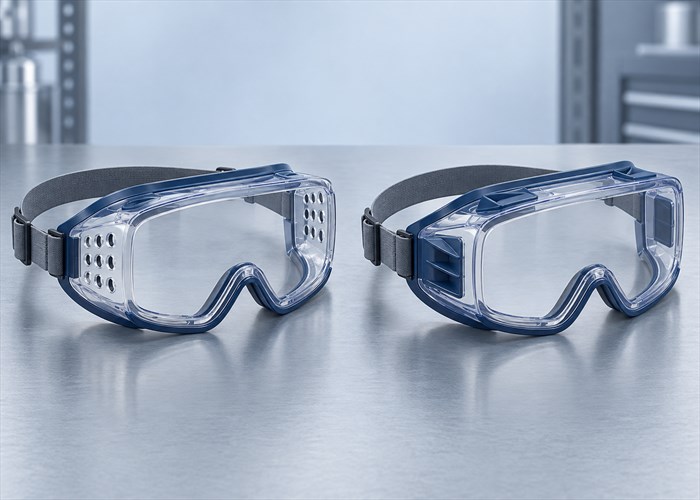
Direct-vented goggles, with open ventilation holes;
Indirect-vented goggles, with partially covered, hooded or baffled openings;
Non-vented goggles, without ventilation openings.
This article concentrates on the first two while using non-vented goggles as a useful point of comparison.
Direct vent safety goggles use openings that provide a relatively open route for air to move into and out of the goggle body. These direct side ventilation holes are commonly associated with impact protection rather than liquid-splash exclusion.
Because the vent path is open, this structure generally permits more direct airflow than a covered vent. That airflow may help reduce fogging in some conditions, but the open path also limits the hazards for which the design may be appropriate.
The same open path explains the principal limitation: a direct vent can provide a route through which liquid or smaller material enters. Directly vented goggles should not be treated as chemical-splash goggles merely because the lens and frame appear to enclose the eyes.
Indirect vent safety goggles also exchange air with the environment, but the openings are partially covered or arranged so that the route is not straight through the goggle body. The precise geometry varies by product: a vent may use a cap, hood, louver or internal baffle. The common structural idea is that incoming material must change direction rather than travel through an unobstructed hole.
Indirect ventilation does not mean that a goggle is sealed. Air can still move through the vent channel, and the finished product remains dependent on its complete construction and fit. It also does not establish protection from every dust, mist, vapor or chemical exposure. The vent type must be read together with applicable markings, test evidence, limitations and instructions for the exact model.
| Feature | Direct vent safety goggles | Indirect vent safety goggles |
|---|---|---|
| Basic vent path | Relatively open ventilation holes | Covered, hooded or baffled ventilation route |
| Air exchange | More direct | Air follows a restricted or redirected path |
| Typical hazard context | Impact, larger particles and some general dusty conditions | Fine dust, splash, droplets and sprays when the complete product is designed and marked accordingly |
| Liquid entry limitation | Open vents may allow splash entry | Covered vents restrict direct splash entry but do not create a gas-tight seal |
| Fogging consideration | More open airflow may reduce fogging | More restricted airflow may increase fogging under some conditions |
| Evidence still required | Model marking, applicable test documentation, fit and limitations | Model marking, applicable test documentation, fit and limitations |
The table describes the structural distinction; it is not a universal performance claim for every vented goggle. A product title or visible vent shape alone cannot confirm its impact, dust or splash rating.
The type of airborne material also matters. Larger particles and nuisance dust may allow a broader choice of vent styles, while fine dust generally calls for indirect or non-vented goggles. Liquid splash, droplets and sprays are typically associated with indirect ventilation, whereas irritating mist may require a non-vented design. OSHA's selection guide reflects these distinctions and identifies D3 for splash/droplet, D4 for dust and D5 for fine dust under the ANSI/ISEA Z87.1-2020 framework it references.
These categories are why the general phrase “dust goggles” is not enough to define an exposure or select a product. Particle size, concentration and direction of travel should be considered alongside the exact model’s markings, applicable standard, test evidence and instructions. Requirements can also differ by destination market.
Fogging occurs when moisture condenses on a lens and reduces visibility. Temperature, humidity, worker exertion, face coverings, respirators, fit, ventilation and lens treatment can all influence the result. Vent style is one factor, not a complete prediction of anti-fog performance.
Direct vents provide a more open route for air exchange, which can help reduce moisture buildup in some conditions. Indirect vents restrict and redirect that airflow to limit direct entry, so the balance between protection and fog control becomes more dependent on the total design. Well-designed indirect vents may still provide useful airflow, so “indirect” does not automatically mean “poor ventilation.”
An anti-fog product name or coating claim should still be verified at model level. Vent configuration, coating, fit and working conditions interact, and no single feature can guarantee a fog-free lens in every environment.
The main difference between direct vent and indirect vent safety goggles is the path through which air enters and leaves the goggle. Direct vents use relatively open holes that support airflow but may permit more direct entry. Indirect vents use covered or redirected paths that restrict straight-line entry while retaining some air exchange.
That structural difference helps explain the association of direct ventilation with impact or larger particles and indirect ventilation with fine dust or splash categories. It does not, by itself, certify a product for any hazard. The complete goggle, fit, markings, test evidence and documented limitations remain decisive.
Readers comparing product structures can review examples of dust protection goggles alongside the broader eye protection and safety glasses categories. These product pages provide visual context, while supported performance must remain tied to each item number.
Copyright © Hebei Sinotools Industrial Co.,Ltd. All Rights Reserved | Powered by  Sitemap