Hand injuries remain one of the most common workplace safety problems across manufacturing, warehousing, metal fabrication, glass handling, and logistics industries. In many industrial environments, ordinary work gloves are no longer sufficient to protect workers from sharp edges, blades, sheet metal, or abrasive materials.
As workplace safety standards continue to improve, cut resistant gloves have become an important category within industrial hand protection products. Modern anti-cut gloves are designed not only to reduce injury risks, but also to maintain grip, flexibility, comfort, and productivity during daily industrial operations.
For PPE distributors and industrial safety suppliers, understanding glove materials, coating technologies, and real application scenarios is essential when selecting products for different market segments.
Cut resistant gloves are industrial safety gloves manufactured with engineered fibers and reinforced materials that help reduce the risk of cuts and lacerations caused by sharp objects.
Unlike ordinary cotton gloves, cut resistant gloves are specifically designed for environments involving:
-Sharp metal edges
-Glass handling
-Sheet metal processing
-Blade contact risks
-Abrasive industrial tasks
Today’s industrial users also expect gloves to provide:
-Comfortable long-term wear
-Good dexterity
-Reliable grip performance
-Breathability
-Abrasion resistance
Because of this, modern cut resistant gloves often combine protective yarns with nitrile, PU, or latex coatings to improve overall workplace performance.
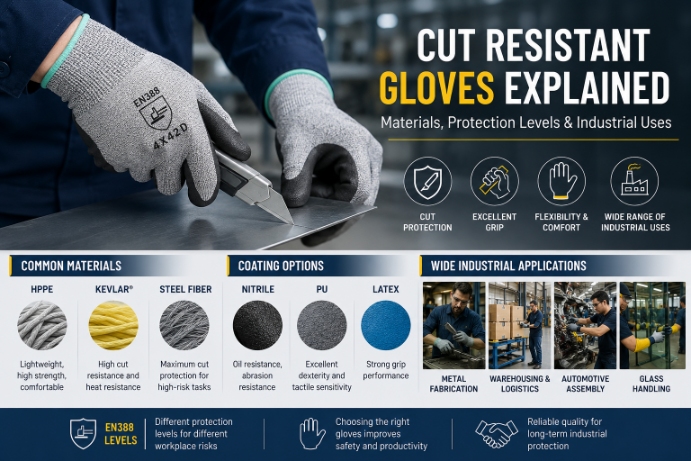
Different materials provide different balances of protection, flexibility, durability, and comfort. Selecting the right material depends heavily on workplace conditions and end-user preferences.
HPPE has become one of the most widely used materials in modern cut resistant gloves due to its lightweight structure and strong cut protection performance.
Advantages of HPPE gloves include:
• High strength-to-weight ratio
• Comfortable fit for long working hours
• Good flexibility and dexterity
• Suitable for precision handling tasks
• Lower hand fatigue during repetitive work
HPPE gloves are widely used in warehousing, automotive assembly, logistics, and light industrial manufacturing.
Kevlar is well known for combining cut resistance with heat resistance. Compared with HPPE, Kevlar-based gloves are often selected for environments involving both sharp materials and elevated temperatures.
Typical applications include:
• Metal fabrication
• Welding support work
• Glass manufacturing
• Heavy industrial handling
Kevlar gloves are generally valued for durability and thermal resistance in demanding industrial conditions.
Some high-level cut resistant gloves incorporate steel fibers or metal mesh components to achieve stronger cut protection.
These gloves are commonly used in:
• Meat processing
• Heavy sheet metal handling
• Glass production
• High-risk cutting environments
Although they provide excellent protection, steel fiber gloves are typically heavier and less flexible than lightweight HPPE gloves.
Different industries face very different hand injury risks, which directly affects glove selection standards.
| Industry | Common Hand Injury Risks | Typical Glove Preference |
|---|---|---|
| Metal Fabrication | Sharp sheet metal, abrasion | High cut resistance nitrile coated gloves |
| Warehousing & Logistics | Carton cutting, repetitive handling | Lightweight HPPE gloves |
| Automotive Assembly | Oil exposure, small parts handling | PU or nitrile coated cut gloves |
| Glass Handling | Sharp edge cuts | High-level anti-cut gloves |
| Machinery Maintenance | Abrasion, oil grip requirements | Durable coated work gloves |
According to occupational safety statistics published by industrial safety organizations, hand injuries consistently rank among the most common workplace injuries in manufacturing and logistics industries. In some industrial sectors, hand-related incidents account for over 20% of recordable workplace injuries, especially in environments involving repetitive material handling or sharp-edge exposure.
For PPE distributors, this is one reason why industrial customers increasingly prioritize gloves that combine both protection and comfort rather than protection alone.
Cut resistant gloves are commonly tested according to ANSI or EN388 standards to help users compare protection performance more easily.
Different protection levels are suitable for different industrial tasks, ranging from light-duty warehouse handling to high-risk metal fabrication environments. In actual purchasing decisions, many industrial users balance cut protection together with flexibility, grip performance, and wearer comfort.
Because protection standards and testing methods can vary between markets, distributors often select glove ranges according to local industry requirements and customer preferences.
Related reading: Anti-Cutting Gloves Levels
Palm coatings play an important role in improving glove durability, grip, and workplace usability.
| Coating Type | Main Advantages | Common Applications |
|---|---|---|
| Nitrile | Oil resistance, abrasion resistance | Automotive, machinery handling |
| PU | Flexibility, tactile sensitivity | Precision assembly work |
| Latex | Strong grip performance | General handling applications |
In oily industrial environments, nitrile coated gloves are often preferred because they maintain grip stability better than many general-purpose glove materials.
Meanwhile, PU coated gloves are widely used in electronics assembly and precision manufacturing because of their lightweight feel and flexibility.
Cut resistant gloves have become an essential part of modern industrial workplace safety across manufacturing, logistics, automotive, metalworking, and handling industries. With different materials, coating technologies, and glove constructions available, selecting the right hand protection solution depends on balancing protection, comfort, flexibility, and workplace efficiency.
Copyright © Hebei Sinotools Industrial Co.,Ltd. All Rights Reserved | Powered by  Sitemap