Cut resistant gloves are widely used in manufacturing, warehousing, metal fabrication, glass handling, automotive assembly, and many other industrial environments where workers may come into contact with sharp tools or materials. However, not all anti-cutting gloves provide the same level of protection.
Different workplaces involve different cutting hazards, which is why anti-cutting gloves are tested and classified according to standardized protection levels. Understanding these ratings can help safety managers, industrial buyers, and workers select gloves that balance protection, comfort, flexibility, and workplace efficiency.
In practice, choosing the correct cut resistance level is often more important than simply selecting the highest protection available.
Cut resistance levels measure how much force a glove material can withstand before being cut under standardized laboratory testing conditions. These ratings are designed to help users compare glove performance more consistently across different products and applications.
The two most widely used standards are:
• ANSI/ISEA 105 (commonly used in North America)
• EN388 (commonly used in Europe and many international markets)
Both standards evaluate cut protection performance, although their testing methods and rating systems are different.
The ANSI/ISEA 105 standard classifies gloves from A1 to A9 according to the amount of cutting force required to cut through the glove material.
| ANSI Level | Cutting Force | Typical Risk Level |
|---|---|---|
| A1-A2 | Low | Light handling tasks |
| A3-A4 | Medium | Warehousing and logistics |
| A5-A6 | High | Metal fabrication and glass handling |
| A7-A9 | Extreme | Heavy industrial cutting hazards |
Higher ANSI levels provide stronger cut protection, but they may also reduce glove flexibility or tactile sensitivity depending on the glove construction.
EN388 is another widely used glove testing standard, especially in Europe. In addition to cut resistance, EN388 also evaluates:
• Abrasion resistance
• Tear resistance
• Puncture resistance
• Impact protection
Modern EN388 testing commonly uses the TDM blade test, which measures resistance against a straight blade under controlled pressure.
| EN388 Rating | Protection Level | Typical Applications |
|---|---|---|
| A-B | Light cut protection | General material handling |
| C-D | Medium cut protection | Warehousing and assembly |
| E-F | High cut protection | Glass and metal industries |
Although ANSI and EN388 ratings are not directly identical, both standards help users identify gloves suitable for different workplace hazards.
While both standards evaluate cut resistance, they are more commonly used in different regional markets.
| Standard | Main Market | Rating System |
|---|---|---|
| ANSI/ISEA 105 | North America | A1-A9 |
| EN388 | Europe & International Markets | A-F |
ANSI testing is generally based on gram-force measurements, while EN388 commonly uses TDM testing for modern cut protection evaluation.
Because industrial safety requirements vary between countries and industries, many glove manufacturers provide products tested under both standards.
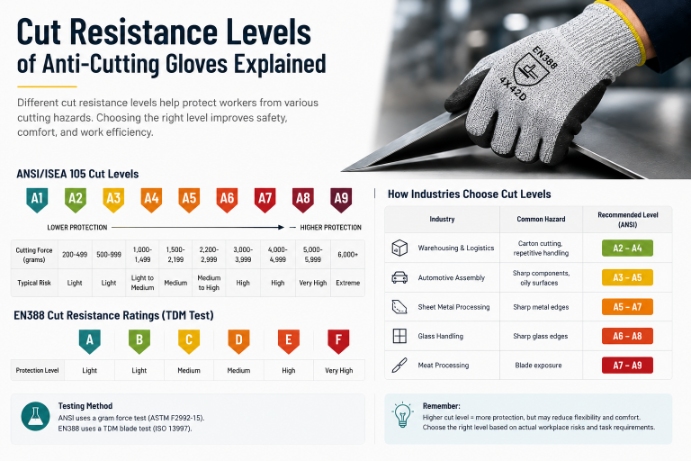
Different working environments involve very different cutting risks. In many cases, selecting the correct protection level depends on balancing safety, dexterity, grip performance, and comfort.
| Industry | Common Hazard | Recommended Level |
|---|---|---|
| Warehousing & Logistics | Carton cutting and repetitive handling | A2-A4 |
| Automotive Assembly | Sharp components and oily surfaces | A3-A5 |
| Sheet Metal Processing | Sharp metal edges | A5-A7 |
| Glass Handling | Sharp glass edges | A6-A8 |
| Meat Processing | Blade exposure | A7-A9 |
For example, warehouse workers often prefer lighter gloves that allow better flexibility and faster movement, while glass handling operations may require significantly stronger cut protection.
A common misunderstanding is that the highest cut resistance level is always the best choice. In reality, excessively heavy gloves can sometimes reduce workplace efficiency or user comfort.
Higher-level gloves may:
• Feel thicker or heavier
• Reduce finger flexibility
• Decrease tactile sensitivity
• Cause more hand fatigue during long shifts
Lower-level gloves, meanwhile, may provide:
• Better dexterity
• Greater comfort
• Improved precision handling
• Faster hand movement
This is why many industrial workplaces select gloves based on actual operational risks rather than simply choosing maximum protection.
Cut Resistant Does Not Mean Cut Proof
No glove can completely eliminate injury risks under all conditions. Cut resistant gloves are designed to reduce the likelihood and severity of injuries, not guarantee absolute protection.
Coating Type Also Matters
Palm coatings such as nitrile, PU, or latex affect grip performance, abrasion resistance, flexibility, and workplace usability. Cut level alone does not determine overall glove performance.
Comfort Influences Workplace Safety
Workers are more likely to consistently wear gloves that feel comfortable and allow natural hand movement. Poor comfort can reduce compliance and workplace efficiency.
Cut resistance levels help classify industrial gloves according to standardized protection performance, making it easier to select suitable hand protection for different workplace hazards. However, the best glove is not always the one with the highest rating.
In practical industrial applications, glove selection often depends on balancing cut protection, flexibility, comfort, grip, and the specific risks involved in daily operations. Understanding ANSI and EN388 standards, as well as the real-world differences between protection levels, can help users make safer and more practical hand protection decisions.
Copyright © Hebei Sinotools Industrial Co.,Ltd. All Rights Reserved | Powered by  Sitemap