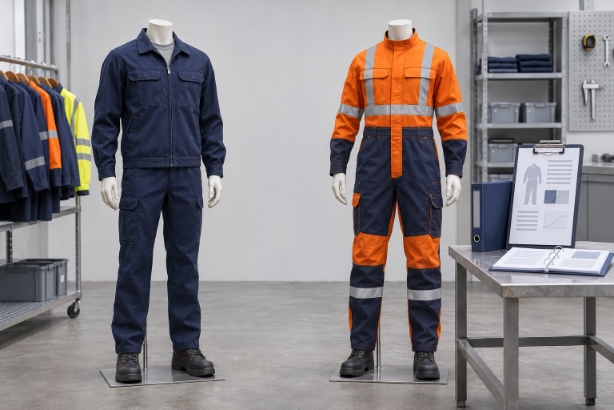
Workwear and protective clothing can look similar, but the terms do not mean the same thing. A coverall, jacket or work suit may be used as an ordinary uniform, or it may be designed to protect against a specific workplace risk. The difference depends on the product’s intended purpose, construction and supporting evidence—not its name alone.
This distinction matters to importers, distributors and procurement teams. It affects how a garment is described, which documents may be required and whether a protective claim can be used in the target market.
Workwear is clothing made for use during work. It can provide body coverage, support a company dress code and create a consistent team appearance. Common examples include work shirts, trousers, coats, two-piece work suits and coveralls.
Ordinary workwear is not automatically personal protective equipment. UK Health and Safety Executive guidance separates ordinary working clothes and corporate uniforms from PPE when they are not specifically designed to protect the wearer’s health or safety. A garment can therefore be durable, practical or suitable for daily work without carrying a verified protective function.
Workwear specifications often focus on details such as:
-fabric composition and weight;
-garment shape and construction;
-pockets, closures and reinforcements;
-available sizes and colors;
-logo, label and packaging options.
These details help define the garment, but they do not by themselves prove protection against heat, flame, chemicals, poor visibility or other workplace hazards.
Protective clothing is designed to reduce exposure to one or more identified risks. Under the EU PPE Regulation, PPE is equipment designed and manufactured to be worn or held for protection against risks to health or safety. OSHA also includes garments such as coveralls, vests and full-body suits among the types of equipment that may serve as PPE.
The phrase protective clothing therefore describes a function, not only a garment style. The required protection may relate to a particular hazard, and the finished product must be supported by the applicable design information, markings, test evidence, certification or instructions for that model and market.
No single garment protects against every hazard. A product designed for visibility has a different purpose from clothing intended for chemical exposure, flame, heat or severe weather. A general term such as “safety coverall” is not enough to establish any of these properties.
| Point of comparison | Ordinary workwear | Protective clothing |
|---|---|---|
| Main purpose | Work coverage, uniformity and practical daily use | Protection against one or more defined risks |
| Product basis | Garment design and general work use | Intended hazard and verified protective function |
| Evidence | Standard garment specifications | Model-specific markings, tests, certificates or instructions as applicable |
| Performance claims | No protective claim should be assumed | Claims must match the supported performance of the exact model |
| Market description | Work clothes, uniforms, work suits or coveralls | Risk-specific protective garment description |
The category name does not settle the classification. Two garments may both be called coveralls while serving different purposes. One may be an ordinary work uniform; another may use a tested design for a defined hazard. Their appearance can be similar even though their documentation and permitted claims are different.
Workwear and PPE are not always separate product shapes. A work garment can also be protective clothing when it is specifically designed and supported for a defined safety function.
For example, HSE guidance notes that ordinary uniforms fall outside PPE rules when they do not specifically protect health and safety. However, clothing that protects against a specific risk can fall within those rules. Weatherproof or insulated clothing may also be treated as PPE when it is worn to protect workers against a health or safety risk.
This means classification depends on the garment’s intended protective purpose and evidence. Adding a company logo does not remove a verified protective function, while adding a protective-sounding name does not create one.
The main difference between workwear and protective clothing is purpose. Workwear supports daily work, coverage and company identity. Protective clothing is designed for protection against a defined risk and requires evidence that supports that function.
A garment name, image or general material description cannot establish protective performance. The exact model, intended use, construction and supporting documents determine which claims can be made. Keeping these categories clear helps suppliers and buyers describe products accurately and match documentation to the correct item.
T-Safety supplies work clothes, coveralls, seasonal workwear, work coats and raincoats under individual item numbers. The range includes ordinary workwear, so no category-wide certification or protective-performance claim applies.
Available fabric details, sizing, colors, branding, packaging and documents are confirmed for the selected model. Where a project requires a specific protective property or target-market standard, the requirement is reviewed against the exact garment and available evidence.
Importers, wholesalers and procurement teams can review the current wholesale protective clothing and workwear range before requesting model-specific information.
Q: Can a company uniform also be protective clothing?
A: Yes. A garment may carry company branding and still be PPE if it is designed and supported for a specific protective function. Branding alone does not determine its classification.
Q: Is every coverall a type of PPE?
A: No. “Coverall” describes the garment form. Some coveralls are ordinary workwear, while others are designed and documented for specific hazards.
Q: Is rainwear always protective clothing?
A: Not always. Its status depends on intended use and the risk it is designed to address. Weatherproof clothing may be PPE when it protects against a health or safety risk, but the term “raincoat” alone does not prove a protective rating.
Q: Does reflective tape make ordinary workwear high-visibility PPE?
A: Not automatically. High-visibility claims must be supported for the complete garment under the applicable requirements. A visible material or trim is not enough on its own.
Copyright © Hebei Sinotools Industrial Co.,Ltd. All Rights Reserved | Powered by  Sitemap